
Start Small, Add Later: How a Stacked Home Battery Grows With Your Family
Most families do not know how much home storage they will need in three years. A new appliance, an electric vehicle charger, or a home office can change the picture fast. A stacked battery is built for that uncertainty: you start with the capacity you need today, and add modules later, instead of buying one oversized system up front.
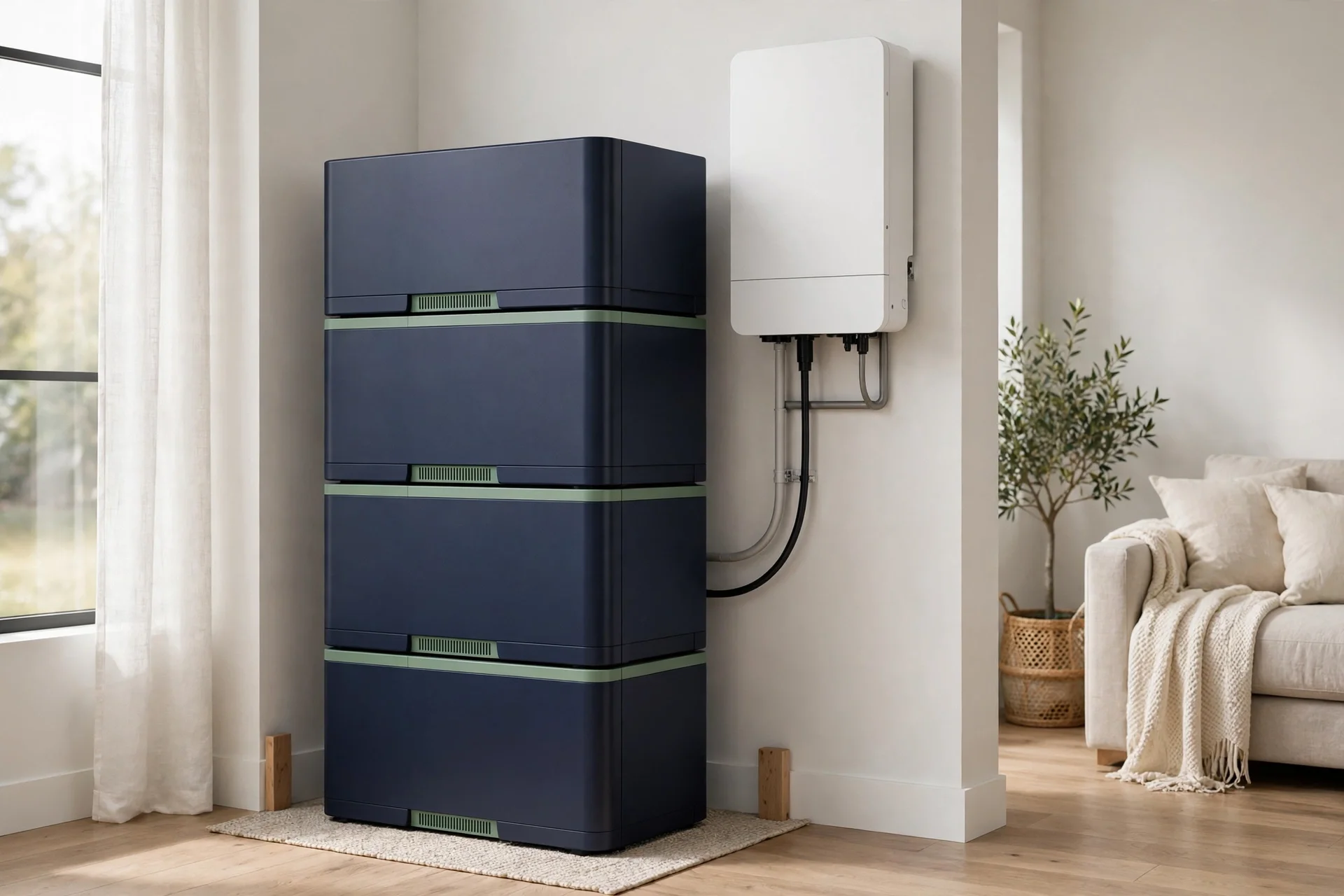
Illustrative scene: stacked home battery modules. The image shows the product type, not one specific model.
Why starting small makes sense
A single large battery forces you to guess your future use on day one. Guess too small and you run out at night. Guess too big and you pay for capacity you may not use for years. A modular system avoids that trade-off.
- Lower starting cost: cover the essentials first, then invest more only when demand actually grows.
- Less wasted capacity: each added module matches a real need, such as an air conditioner or an EV charger.
- Easier to live with: modules stack in a compact footprint instead of taking over a wall of bulky battery banks.
How expansion actually works
A low voltage stacked system is made of several battery modules placed one on top of another. Each module works as part of a larger unit, so adding capacity is mainly a matter of adding a module, not replacing the whole system. Low voltage systems are also generally easier to install and maintain than high voltage systems, which makes them a practical fit for homes.
Most modern stacked systems use LiFePO4 cells, known for strong thermal stability and long service life. A built-in battery management system watches voltage, current, temperature, and state of charge in real time, and helps protect against overcharging, over-discharging, overheating, and short circuits.
A practical way to plan it
- Cover the essentials first: lights, refrigerator, router, and security equipment.
- Size for the night, not the roof: think about how much solar power you actually use after sunset.
- Leave room to grow: keep floor space and access clear for one more module.
- Check compatibility: confirm the system works with your inverter and solar setup before you buy.
Questions, answered briefly
Can I really add modules later? That is the point of the stacked design. Expansion is planned in, rather than improvised afterwards.
Does low voltage mean low performance? No. Low voltage here describes the system design, which is easier to install and maintain in a home. What matters for daily use is usable capacity and how well the system matches your loads.
Is it only for solar homes? Solar is the most common pairing, but a stacked system can also store energy during low-cost periods and provide backup during an outage.