
Smarter, Not Just Stronger: Why LiFePO4 Replaces Lead-Acid in Solar, RV and Marine Use
In a camper van, every kilogram and every watt counts. The battery has to fit under a bench, survive bumpy roads, charge from solar when the sun is out, and still run lights and a fridge at night. That is why the shift from lead-acid to LiFePO4 is not just about a new battery. It is about a battery that was designed for how mobile power actually works.
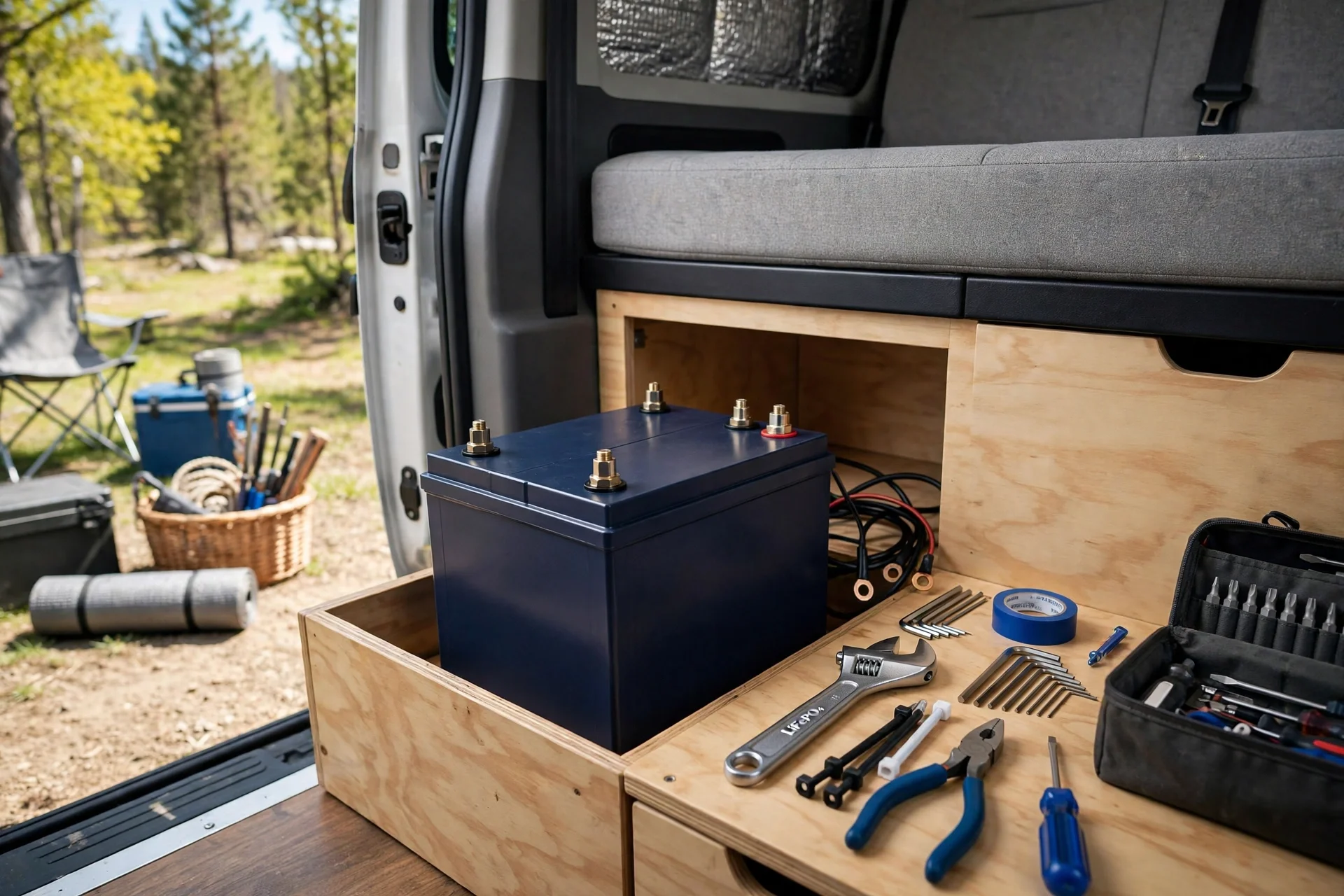
Illustrative scene: a deep cycle battery fitted in a camper van. The image shows the product type, not one specific model.
Why the chemistry matters on the road
A LiFePO4 Deep Cycle Battery uses lithium iron phosphate chemistry, widely recognized for excellent thermal stability and safety. Compared with lead-acid, it is much lighter, charges faster, and delivers more usable energy. For solar systems, RVs, marine equipment, and golf carts, that combination matters: less weight to carry, less time waiting to recharge, and more energy from the same space.
Fast, efficient charging is especially valuable in solar use, where every watt of generated energy matters. Higher charging efficiency means less energy wasted during the charging process, and a faster return to full charge when the sun is limited.
Long life, built-in protection, lighter footprint
Service life is the other major change. A typical lead-acid battery may last only a few hundred cycles, depending on usage and maintenance. A quality LiFePO4 battery can provide thousands of charge and discharge cycles while keeping strong capacity, which means fewer replacements and less waste over time.
Safety follows the chemistry. Lithium iron phosphate is more stable than many other lithium chemistries, resistant to overheating, and has a lower risk of thermal runaway. Most modern LiFePO4 batteries also include a built-in Battery Management System, which protects against overcharging, over-discharging, short circuits, and temperature problems. LiFePO4 batteries are also environmentally friendlier than lead-acid: they do not contain toxic lead or acid, and their long lifespan reduces waste.
Questions, answered briefly
Is it suitable for all mobile uses? Solar, RV, marine, and golf cart uses are the most common fits. Always check size, charger settings, and mounting requirements for your specific vehicle or vessel.
Does "smarter" mean maintenance-free? It means less maintenance and built-in protection, not zero care. Connections, charging settings, and storage conditions still matter.