
Reliable Replacement, Simpler Maintenance: LiFePO4 for Off-Grid and Backup
As energy storage technology continues to advance, more users are choosing the LiFePO4 deep cycle battery as a reliable replacement for traditional lead-acid batteries. Whether used in solar energy systems, RVs, marine applications, backup power, or off-grid homes, the replacement decision is usually made for the same reason: less maintenance, more usable energy, and longer life.
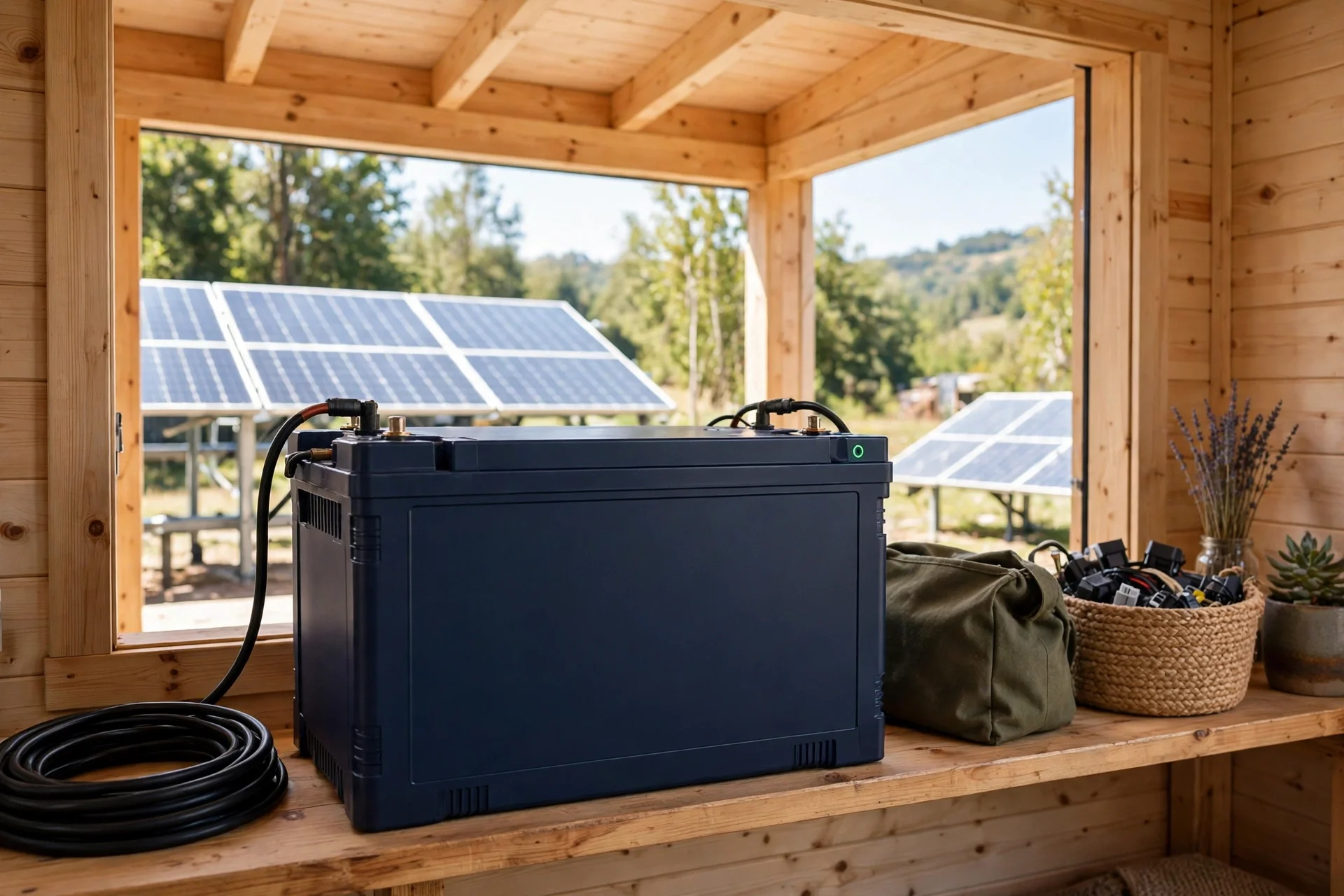
Illustrative scene: a deep cycle battery in an off-grid cabin with solar panels. The image shows the product type, not one specific model.
Longer life, more usable capacity, lighter weight
One of the biggest advantages is long service life. Traditional lead-acid batteries often last only a few hundred cycles, especially when deeply discharged on a regular basis. In contrast, a high-quality LiFePO4 battery can provide thousands of cycles under proper operating conditions, meaning fewer replacements and more stable long-term performance.
Another major benefit is usable capacity. Lead-acid batteries are usually not recommended to be discharged below 50%, because deep discharge can damage the battery and shorten its lifespan. LiFePO4 batteries, however, can safely use a much higher percentage of their capacity, often 80% or more, giving more usable energy from a similar size. LiFePO4 deep cycle batteries are also much lighter than lead-acid batteries, especially important for mobile applications such as RVs, boats, golf carts, and portable power systems, where lighter weight reduces vehicle weight, improves energy efficiency, and makes installation easier.
Safer, solar-ready, and simpler to maintain
Safety is another reason LiFePO4 chemistry has become popular. Compared with some other lithium battery types, LiFePO4 is known for excellent thermal stability and a lower risk of overheating, with most modern batteries equipped with a built-in Battery Management System for protection against overcharging, over-discharging, and short circuits.
In renewable energy systems, LiFePO4 batteries are particularly valuable. Solar power systems require batteries that can charge efficiently during the day and discharge reliably at night, and LiFePO4 batteries offer high charge acceptance, low self-discharge, and stable voltage output, so stored energy is available when it is needed, not just when it is generated. Maintenance is also much simpler: lead-acid batteries may require regular inspection, ventilation, equalization charging, and careful handling, while LiFePO4 batteries are generally maintenance-free and can be installed in more flexible environments, with clean operation and no acid to manage. In conclusion, the LiFePO4 deep cycle battery is an excellent alternative to traditional lead-acid batteries, offering longer life, higher usable capacity, lighter weight, improved safety, and better energy efficiency, and as demand grows for reliable and sustainable power storage, it will continue to play a central role.
Questions, answered briefly
Does low self-discharge matter for backup? Yes. A battery that holds its charge longer is more likely to be ready after weeks of standby, which is exactly when backup is needed.
Does maintenance-free mean no checks at all? No. It means no routine acid, watering, or equalization work, but connections, ventilation, and BMS status should still be checked periodically.